The Future of Last-Mile Delivery with Automation and Robotics
December 24, 2025
In today’s hyper-connected world, last-mile delivery — the final step of getting a package from a distribution center to the customer’s doorstep — has become one of the most critical and costly parts of the logistics chain. Traditionally accounting for up to 50% of total delivery costs, this segment is plagued by inefficiencies caused by traffic, unpredictable urban environments, and rising labor costs. With the surge in e-commerce and same-day delivery expectations, companies are rapidly turning to automation and robotics to revolutionize last-mile logistics, creating smarter, faster, and more sustainable delivery ecosystems.
Why Last-Mile Delivery Matters
The last mile is the most visible part of delivery for customers and the most expensive for companies. With consumer demand for faster, cheaper, and more flexible delivery options rising, traditional delivery models — reliant on human couriers and fuel-powered vehicles — are struggling to keep pace. This dilemma has prompted logistics companies to innovate aggressively, leveraging cutting-edge technology to make last-mile delivery more efficient, reliable, and eco-friendly.
Automation: The Backbone of Modern Logistics
At the heart of last-mile transformation is automation. Automation spans a range of technologies — from AI-driven route planning and autonomous vehicles to robotic sorting and warehouse automation. These systems improve operational efficiency by processing large volumes of data, predicting demand, and optimizing routes in real time. By leveraging machine learning and predictive analytics, businesses can cut unnecessary travel, reduce fuel consumption, and minimize delivery delays.
AI-powered systems continually analyze traffic patterns, weather conditions, and delivery windows to suggest the most efficient route for each delivery. This not only shortens delivery times but also reduces operational costs and carbon emissions — a crucial win in an era where sustainability is as important as speed.
Robots on the Ground: Autonomous Delivery Units
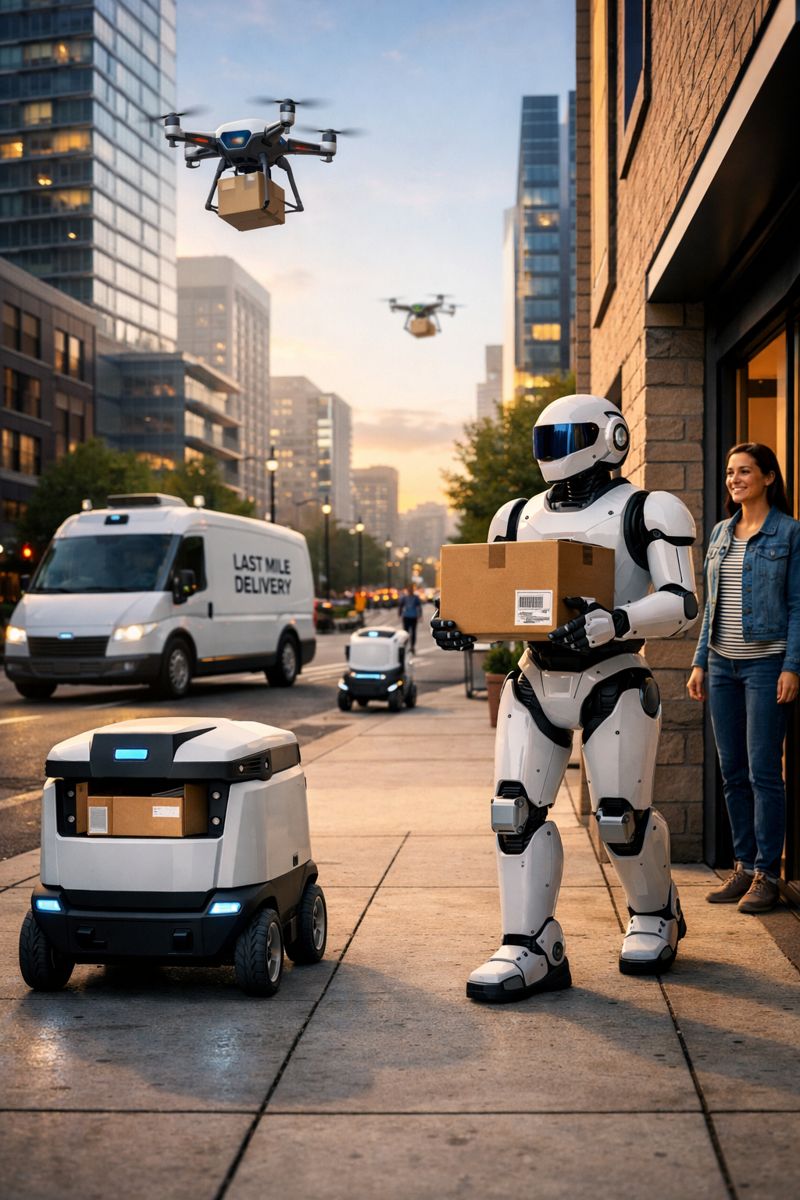
One of the most exciting developments in last-mile logistics is the deployment of autonomous delivery robots. These compact, self-navigating machines can travel on sidewalks and streets to deliver packages, groceries, food, and other goods directly to customers without human intervention. They use a combination of cameras, GPS, LiDAR, and AI algorithms to detect obstacles, navigate complex environments, and ensure safe deliveries.
Delivery robots are already being tested and rolled out in cities around the world. For example, companies like Serve Robotics have partnered with major food delivery platforms to deploy fleets of sidewalk robots across U.S. cities, completing tens of thousands of deliveries. Meanwhile, global brands like Uber Eats are launching autonomous bots in cities in the UK with the promise of delivering meals in under 30 minutes.
The benefits of these robots are clear:
-
Reduced Labor Costs: Without the need for human drivers, delivery companies can cut down significantly on wages, benefits, and related expenses.
-
24/7 Operations: Robots don’t require breaks or shifts, enabling around-the-clock deliveries that meet customer demand at all hours.
-
Eco-Friendly: Most autonomous robots run on electric power, reducing carbon emissions compared to traditional delivery vehicles.
-
Improved Reliability: Robotics systems can operate with fewer errors and greater consistency, boosting customer satisfaction.
Drone Delivery: Taking It to the Skies
Ground robots aren’t the only innovation reshaping last-mile delivery — drones are also playing a significant role. Aerial drones can bypass road traffic entirely, bringing packages quickly to customers in dense urban areas and even remote rural locations where traditional delivery is slower and more expensive.
Drones are particularly effective for urgent deliveries, such as medical supplies, where reducing delivery time even by minutes can be critical. By flying above congested streets, drones help logistics providers meet tight delivery windows and expand service coverage in ways previously unimaginable.
Smarter Warehouses: Robotics Behind the Scenes
While much attention is given to delivery bots on roads and sidewalks, automation inside warehouses and fulfillment centers is equally transformative. Robotics in warehouses — like automated guided vehicles (AGVs), robotic arms, and automated sorting systems — increases order processing speed, accuracy, and throughput.
These systems can quickly pick, pack, and sort thousands of packages with minimal human intervention. By reducing manual labor in repetitive, time-consuming tasks, companies can speed up order fulfillment, enabling same-day or next-day delivery services that customers increasingly expect.
The Sustainability Advantage
The shift to automation and robotics has significant environmental benefits. Electric delivery robots and drones produce fewer emissions than gasoline or diesel-powered vehicles, helping companies reduce their carbon footprint. Moreover, by optimizing routes and reducing needless travel, AI systems further cut energy use and emissions. This aligns with growing regulatory and consumer pressure for greener logistics solutions — a powerful incentive for innovation.
Challenges and Barriers Ahead
Despite the promise, the future of automated last-mile delivery is not without obstacles. Regulatory frameworks for autonomous robots and drones are still in development in many countries. Clear rules governing where and how these technologies can operate — from airspace regulations for drones to sidewalk robot permissions — are essential for widespread adoption.
Infrastructure readiness is another challenge. Uneven sidewalks, lack of dedicated lanes for robots, and rural terrain can hinder performance. Investments in smart city infrastructure, such as IoT-enabled traffic systems and robot-friendly pathways, will be crucial to support mass deployment.
Data privacy and cybersecurity also loom large. Automated systems rely heavily on sensors and networked data to function. Protecting customer information and ensuring robust cybersecurity measures are in place is critical to maintain trust and safety.
Human-Robot Collaboration
Contrary to fears that robots will eliminate jobs, many experts see a future where humans and robots collaborate. Automation can take over repetitive, low-value tasks, freeing human workers to focus on strategic, creative, and supervisory roles. Workers may transition into roles such as robot maintenance technicians, system analysts, and AI trainers — creating new opportunities in a more technologically advanced logistics workforce.
What Comes Next?
The trajectory of last-mile delivery clearly points toward a hybrid ecosystem where autonomous robots, drones, and AI-powered systems work alongside human talent to create fast, reliable, and sustainable delivery networks. As technology continues to evolve, we can expect:
-
Wider adoption of autonomous vehicles, including larger self-driving vans and trucks;
-
More sophisticated routing algorithms that adjust in real-time to traffic, weather, and delivery conditions;
-
Collaborative delivery models leveraging multiple modes — from drones and robots to traditional couriers — to enhance efficiency.
Studies forecast that robotic last-mile delivery revenues will grow substantially over the next decade, underscoring that this is not just a niche innovation but a mainstream shift in global logistics.
Conclusion
The future of last-mile delivery is being reshaped by automation and robotics in profound ways. As technology matures, businesses that embrace these innovations will be better equipped to meet customer expectations for speed, flexibility, and sustainability. While challenges remain, the opportunities created by automation — from cost savings and environmental benefits to improved delivery experiences — signal a new era in logistics. For companies ready to invest in robotics and AI, the result will be faster, smarter, and more resilient delivery networks that define the competitive edge in the digital economy.