FTL vs LTL vs Intermodal: What’s Best for Your Shipping Needs?
November 26, 2025
Choosing the right shipping method is one of the most important decisions for any shipper. With increasing freight demand, rising transportation costs, and pressure to deliver goods faster than ever, understanding the difference between FTL, LTL, and Intermodal shipping can help reduce costs and improve reliability. Every business has different shipping needs — volume, budget, route, urgency, product type, and customer expectations. That’s why the most successful shippers are those who choose the right mode for every shipment.
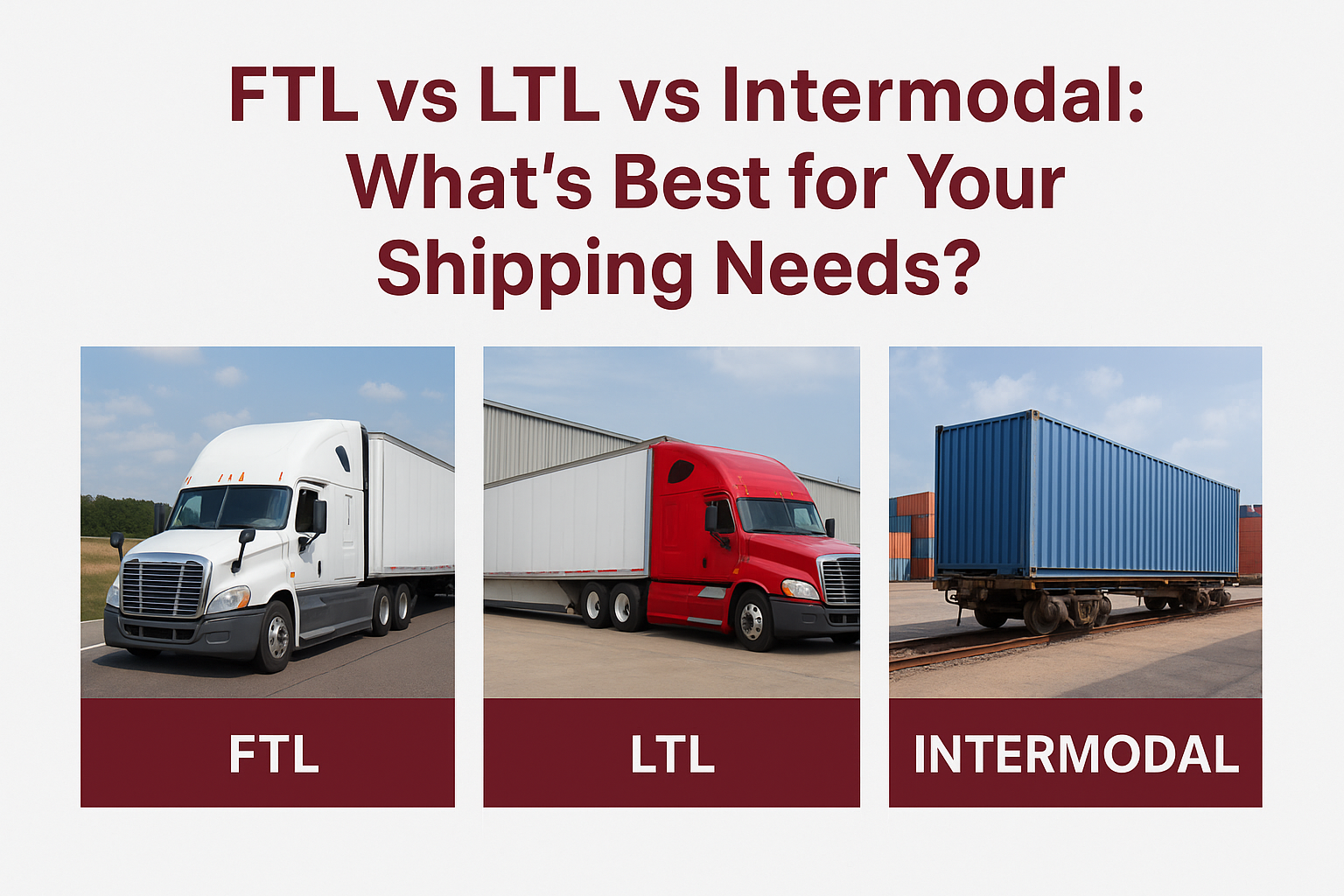
What Is FTL (Full Truckload)?

FTL stands for Full Truckload. This is when a shipper uses an entire truck for one shipment. Even if the truck isn’t 100% full, the space is dedicated to a single customer.
How FTL Works
-
Freight stays on the same truck from pickup to delivery.
-
There are no transfers or unloading between terminals.
-
Transit is usually much faster than other methods.
Best For:
✔ Large shipments (10,000+ lbs)
✔ Time-sensitive cargo
✔ High-value or fragile products
✔ Businesses that need door-to-door delivery
✔ Dedicated lanes or recurring shipments
Pros of FTL
-
Fastest transit time — fewer stops and no transfers.
-
Lower risk of damage — freight stays on one truck.
-
More secure — ideal for valuable cargo.
-
Cost-efficient for large loads.
Cons of FTL
-
More expensive for small shipments.
-
Prices fluctuate with market conditions, fuel costs, and capacity.
What Is LTL (Less-Than-Truckload)?
LTL is designed for shipments too big for parcel shipping but too small for a full truckload. Multiple shippers share space on the same truck, making it cost-effective.
How LTL Works
-
Freight moves from pickup to a terminal.
-
It may be loaded/unloaded 3–7 times.
-
Trucks make multiple stops carrying freight from different shippers.
Best For:
✔ Small shipments (150–10,000 lbs)
✔ Businesses trying to reduce shipping costs
✔ Non-urgent deliveries
✔ Frequent small-volume shipments
✔ Palletized freight
Pros of LTL
-
Cost savings — you only pay for the space you use.
-
Ideal for SMEs — great for businesses not shipping full truckloads.
-
Environment-friendly — shared truck space reduces carbon emissions.
Cons of LTL
-
Longer transit times due to multiple stops.
-
Higher risk of damage from unloading and re-loading.
-
Extra fees may apply for liftgate, residential delivery, reclassification, etc.
What Is Intermodal Shipping?
Intermodal shipping combines two or more modes of transportation, such as:
-
Truck
-
Rail
-
Ship
-
Air (less common for freight)
-
Drayage (local trucking around terminals)
Freight is moved in containers, not unpacked or handled between modes.
How Intermodal Works
-
Freight travels in a standardized container.
-
Container moves from truck → rail → truck (or other combinations).
-
No handling of goods when switching modes — only the container is moved.
Best For:
✔ Long-distance shipping (over 700 miles)
✔ Cost-sensitive shipments
✔ Non-urgent freight
✔ Heavy or bulk items
✔ Environment-friendly operations
Pros of Intermodal
-
Lower cost than full-truckload for long distances.
-
Very eco-friendly — rail reduces fuel use up to 75%.
-
Highly secure — sealed containers prevent theft/damage.
-
Great for predictable freight and long hauls.
Cons of Intermodal
-
Longer transit time compared to FTL.
-
Requires drayage at both pickup and delivery points.
-
Not ideal for perishable or extremely time-sensitive products.
FTL vs LTL vs Intermodal: Quick Comparison Chart
| Feature | FTL (Full Truckload) | LTL (Less-Than-Truckload) | Intermodal |
|---|---|---|---|
| Best For | Large loads, urgent freight | Small/medium shipments | Long distances, cost reduction |
| Transit Speed | Fastest | Slow | Moderate |
| Damage Risk | Very Low | Higher | Very Low |
| Cost | Higher | Lowest | Moderate |
| Handling | Minimal | Multiple | Minimal |
| Ideal Distance | Short–Long | Short–Medium | 700+ miles |
| Flexibility | High | Medium | Low–Medium |
| Eco-Friendly | Moderate | Good | Excellent |
When Should You Choose FTL?
Choose FTL when:
✔ You have enough freight to fill most of a truck
✔ Your shipment must arrive fast
✔ You’re shipping fragile, high-value, or sensitive goods
✔ You want minimal handling and maximum security
✔ You need strict delivery windows
Industries that commonly use FTL:
Grocery, retail, automotive, construction, manufacturing.
When Should You Choose LTL?
Choose LTL when:
✔ You have small but frequent shipments
✔ You want the most cost-effective option
✔ Your delivery timeline is flexible
✔ Your items can handle additional handling
Industries that use LTL often:
E-commerce, small businesses, industrial supply, consumer goods.
When Should You Choose Intermodal?
Choose Intermodal when:
✔ You want to reduce long-distance transportation costs
✔ Your shipment isn’t time-sensitive
✔ You value sustainability
✔ You’re shipping heavy or bulk products
Industries suited for Intermodal:
Energy, steel, agriculture, building materials, consumer packaged goods.
Which Option Is Best for Your Business?
Choosing between FTL, LTL, and Intermodal depends on your:
✔ Shipment size
Large loads → FTL
Small loads → LTL
Heavy long-distance freight → Intermodal
✔ Speed requirements
Urgent → FTL
Flexible → LTL or Intermodal
✔ Budget
Lowest cost → LTL
Cost-efficient long haul → Intermodal
✔ Risk tolerance
High-value or fragile → FTL
Durable goods → LTL or Intermodal
✔ Distance
Short haul → FTL / LTL
Long haul → Intermodal
Conclusion: Make the Right Freight Choice Every Time
Each shipping mode plays a unique role in today’s fast-moving logistics world.
-
FTL provides speed, security, and reliability for large or urgent shipments.
-
LTL saves money for smaller freight and gives flexibility to growing businesses.
-
Intermodal blends cost efficiency with sustainability for long-distance transport.
The smartest shippers don’t use just one mode—they choose the right mode for the right shipment.
